Wiki
← Back to articles 
Unlike Texas Hold'em with just 169 unique starting hand combinations, PLO has over 16,000. You can't memorize a simple chart - you need to understand what makes a hand playable.
Here's why:
Good: JT98, QJT9, 8765
Less good: KT72, QJ84, J973
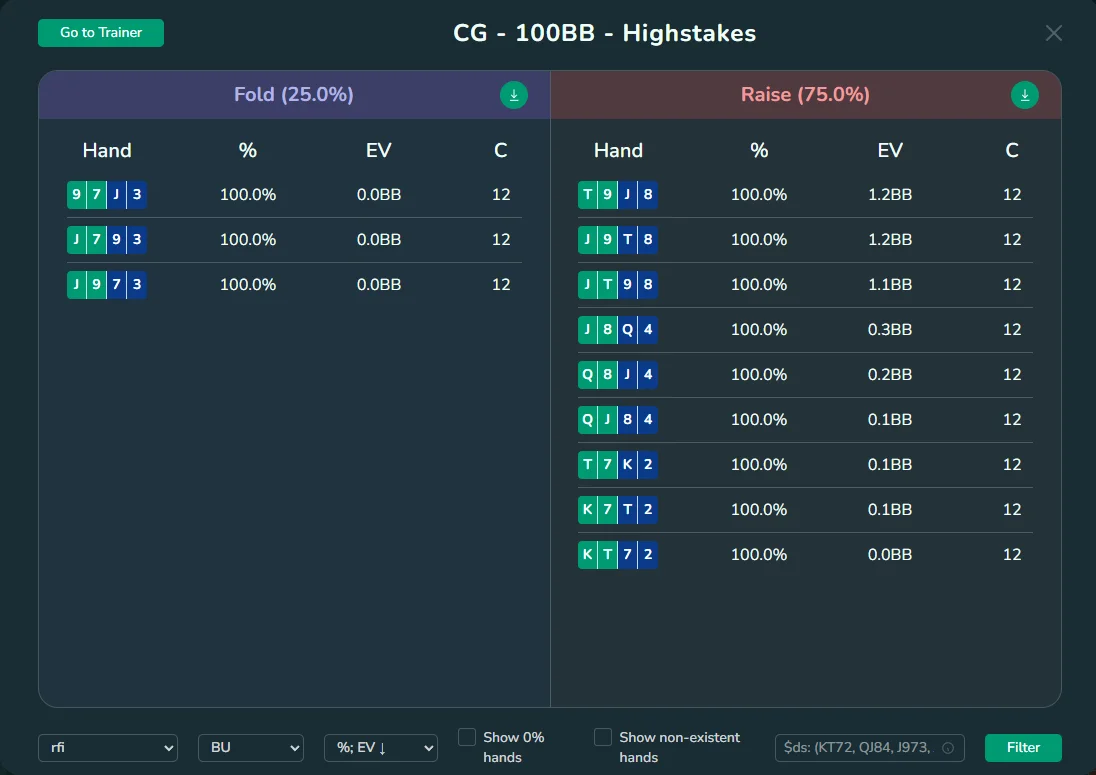
Looking at the button open, JT98 double suited is MUCH more valuable than KT72, QJ84, J973 double suited.
Best: KQJ9 with two suits (K♠Q♠J♥9♥)
Okay: KQJ9 with one suit
Worst: KQJ9 rainbow
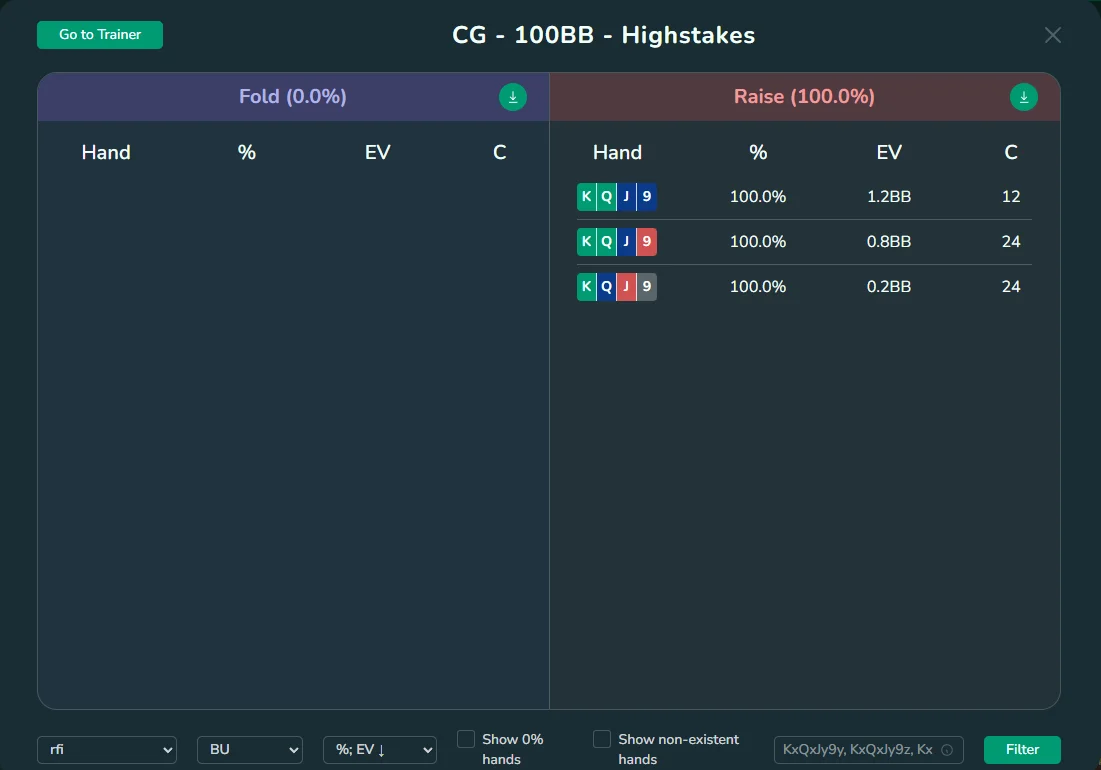
The nut flush potential adds equity on every suited flop - even when you don't have a made hand yet. Take a look at the EVs for KQJ9 with varying suitedness.
Compare: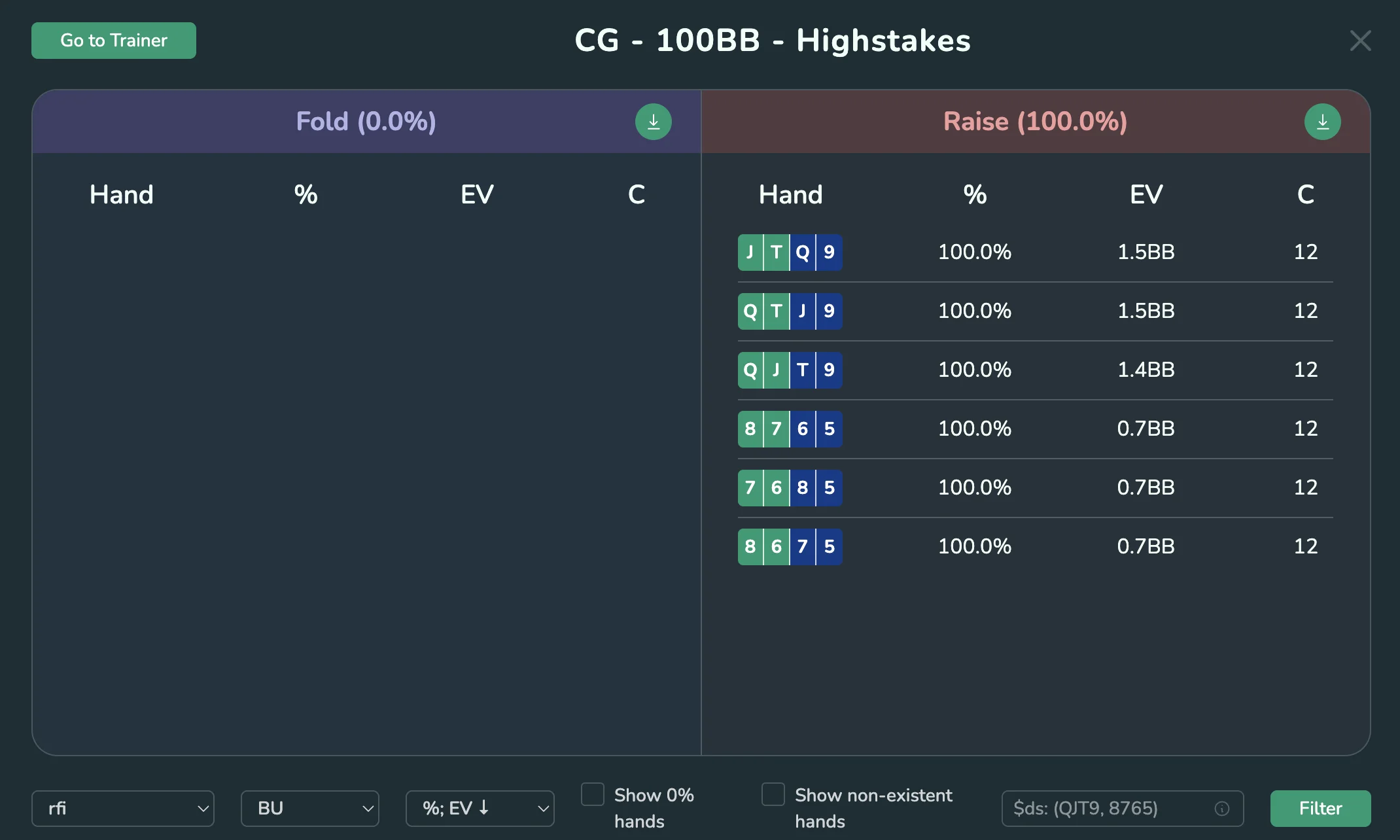
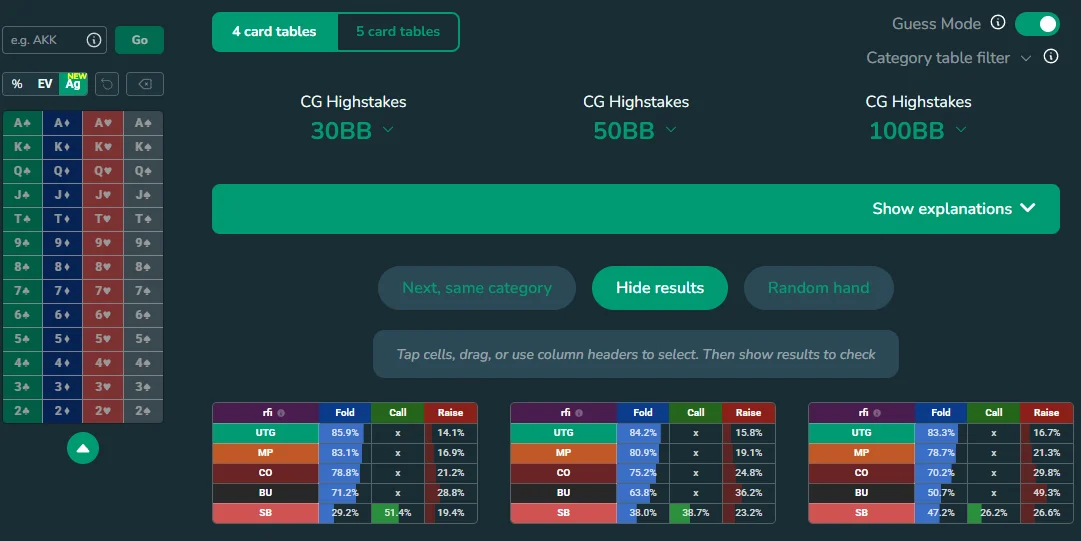
The button opens 49.3% of hands at 100bb (highstakes model) but only 28.8% at 30bb. That's a massive difference - nearly half your range disappears.
Why? It comes down to 3-bet pressure.
At 30bb, when the blinds 3-bet you, they're drastically lowering the SPR (stack to pot ratio). Your weak opens get crushed - you either fold and lose your raise, or you continue with a hand that can't take the heat.
At 100bb, a 3-bet doesn't commit anyone. You can flat in position, see a flop, and outplay them over multiple streets. Getting 3-bet hurts less, so you can open wider.
Position matters more as stacks get deeper. Look at how much wider the button opens compared to UTG:
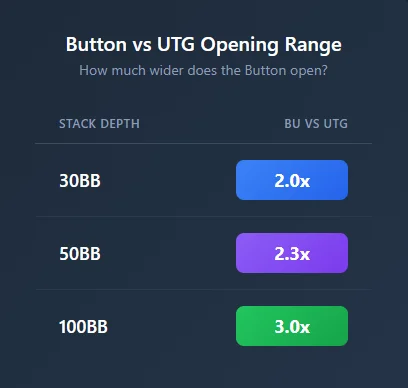
Takeaway: The shorter the stacks, the tighter you open - not because your hands get worse, but because your opponents can punish you harder.
Building a mental model of the aggregate open % is helpful to starting your journey in PLO. From there when you're dealt a hand in a given position, ask yourself "is this hand roughly in the best X% of hands?" You can learn this in a variety of ways in PreflopWhiz - the lab, rangeview, and the trainer.
From UTG, you're often playing OOP and you have to go through 5 more players that could easily have you dominated.
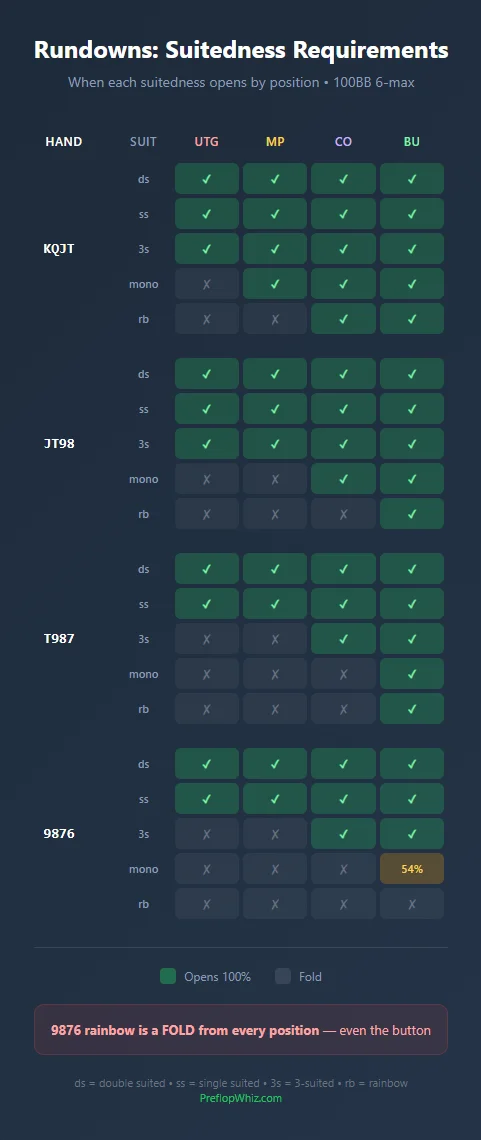
Suitedness matters greatly. A rainbow rundown has no flush backup - when your straight draw misses, you're done. A suited version keeps fighting with flush outs. That difference is worth multiple positions: KQJT single-suited opens from UTG, while KQJT rainbow waits until the cutoff.
KQJT rainbow is still playable from late position - it makes broadway straights that are often the nuts. But as rundowns get lower, two things happen: your straights become more vulnerable to higher straights, and you lose the backup equity that flushes provide.
By the time you get to 9876, rainbow is unplayable from any position - even the button.
The pattern is clear: double-suited and single-suited rundowns open from early position. Rainbow rundowns need late position or get folded entirely. Keep in mind these thresholds shift at lower stacks like we've discussed above.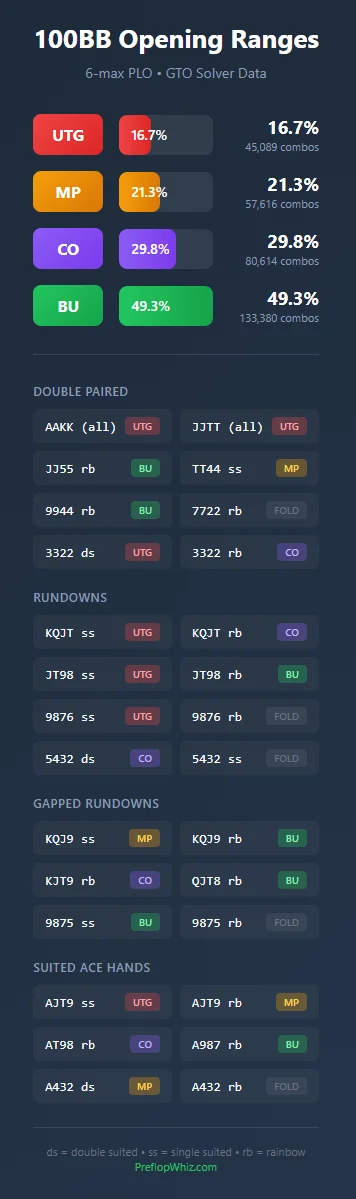
We offer complete PLO5 preflop ranges in PreflopWhiz. 
Try PreflopWhiz Free
PLO starting hands: intro to PLO4 hand selection
Understanding preflop play in PLO is the foundation for your game. Having a bad preflop game is like showing up to the racetrack with worn out tires.Unlike Texas Hold'em with just 169 unique starting hand combinations, PLO has over 16,000. You can't memorize a simple chart - you need to understand what makes a hand playable.
In this guide:
- What makes a PLO hand strong (and what makes it trash)
- How position and stack depth change your opening ranges
- Why suitedness matters more than you think
- PLO4 vs PLO5 differences
1. Why does starting hand selection matter in PLO?
In Hold'em, you can get away with playing marginal hands and outplaying opponents postflop. In PLO, that's a recipe for bleeding money.Here's why:
- Equities run closer together.
- Four cards means more draws, more flushes, more straights - and more opportunities to make the second nuts and pay off the nuts.
- When 3-4 players see a flop, someone usually has it. Weak draws and non-nut hands become liabilities.
2. What makes a good PLO starting hand?
Every strong PLO starting hand shares some combination of these three qualities:2.1 Connectedness
Your four cards should work together to make straights. Connected cards like QJT9 can flop wraps (straight draws with 13+ outs). Disconnected cards like KT72 rarely flop anything clean.Good: JT98, QJT9, 8765
Less good: KT72, QJ84, J973
Looking at the button open, JT98 double suited is MUCH more valuable than KT72, QJ84, J973 double suited.
2.2 Suitedness (double-suited)
Double-suited hands can make two different nut flushes. Single-suited is okay. Rainbow (no suits) is a significant downgrade.Best: KQJ9 with two suits (K♠Q♠J♥9♥)
Okay: KQJ9 with one suit
Worst: KQJ9 rainbow
The nut flush potential adds equity on every suited flop - even when you don't have a made hand yet. Take a look at the EVs for KQJ9 with varying suitedness.
2.3 High card strength
High cards make higher straights, higher flushes, and higher sets. All else equal, higher is better.Compare:
- QJT9 makes the nut straight on K-high boards
- 8765 makes the nut straight on 9-high boards (less common, lower SPR pots)
3. How does stack depth change opening ranges?
Stack depth dramatically affects how wide you can open. Here's the aggregate opening frequency by position at different stack depths: The button opens 49.3% of hands at 100bb (highstakes model) but only 28.8% at 30bb. That's a massive difference - nearly half your range disappears.
Why? It comes down to 3-bet pressure.
At 30bb, when the blinds 3-bet you, they're drastically lowering the SPR (stack to pot ratio). Your weak opens get crushed - you either fold and lose your raise, or you continue with a hand that can't take the heat.
At 100bb, a 3-bet doesn't commit anyone. You can flat in position, see a flop, and outplay them over multiple streets. Getting 3-bet hurts less, so you can open wider.
Position matters more as stacks get deeper. Look at how much wider the button opens compared to UTG:
Takeaway: The shorter the stacks, the tighter you open - not because your hands get worse, but because your opponents can punish you harder.
Building a mental model of the aggregate open % is helpful to starting your journey in PLO. From there when you're dealt a hand in a given position, ask yourself "is this hand roughly in the best X% of hands?" You can learn this in a variety of ways in PreflopWhiz - the lab, rangeview, and the trainer.
4. What are the opening ranges by position? (100bb examples)
Position dramatically affects which hands are profitable to open. From UTG, you're opening around 17% of hands. From the button, nearly 50%.From UTG, you're often playing OOP and you have to go through 5 more players that could easily have you dominated.
Suitedness matters greatly. A rainbow rundown has no flush backup - when your straight draw misses, you're done. A suited version keeps fighting with flush outs. That difference is worth multiple positions: KQJT single-suited opens from UTG, while KQJT rainbow waits until the cutoff.
4.1 Rundown suitedness requirements
The lower your rundown, the more suitedness you need. This is one of PLO's most important concepts that many players get wrong.KQJT rainbow is still playable from late position - it makes broadway straights that are often the nuts. But as rundowns get lower, two things happen: your straights become more vulnerable to higher straights, and you lose the backup equity that flushes provide.
By the time you get to 9876, rainbow is unplayable from any position - even the button.
The pattern is clear: double-suited and single-suited rundowns open from early position. Rainbow rundowns need late position or get folded entirely. Keep in mind these thresholds shift at lower stacks like we've discussed above.
5. How do PLO4 and PLO5 starting hands differ?
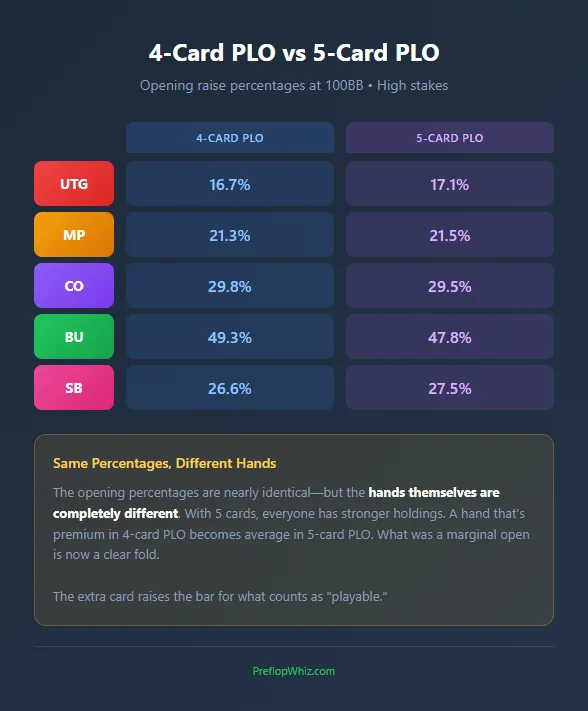
If you're playing 5 card PLO (PLO5), hand values shift significantly. The extra card means:- Hands are stronger on average - everyone has more combinations
- Nut hands appear more often - even more reason to avoid second-best
- Rundowns gain value - easier to have connected cards
We offer complete PLO5 preflop ranges in PreflopWhiz.
6. Key takeaways
- Connectedness and suitedness are king - your four cards should work together to make nut straights and nut flushes
- Suitedness matters more than card ranks - KQJT rainbow is worse than T987 double-suited
- Rainbow low rundowns are trash - 9876 rainbow is a fold from every position, including the button
- Position widens ranges dramatically - UTG opens 17%, button opens 49%. That's not a tweak, it's a different strategy.
- Shorter stacks mean tighter opens - not because hands get worse, but because 3-bet pressure punishes you harder
- PLO5 has the same percentages, different hands - the extra card raises the bar for what's playable
Ready to master PLO preflop?
PreflopWhiz gives you instant access to Monkersolver-generated preflop ranges for every position, stack depth, and game format.Try PreflopWhiz Free